
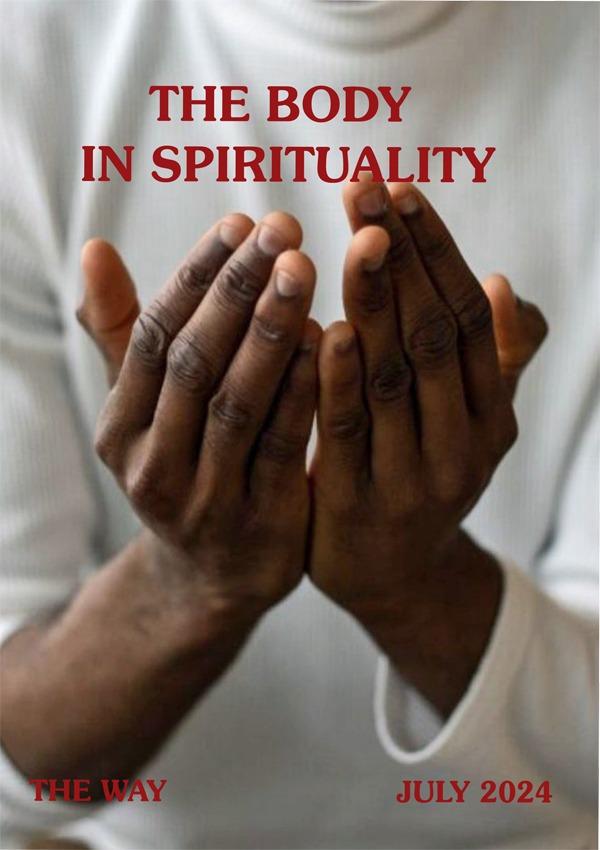
In the Spiritual Exercises, St Ignatius is always attentive to the spiritual importance of the body. He invites us to inhabit the gospel not only through our thoughts and feelings but also through our posture, gestures and senses. In this way we enter into a deeper relationship with Christ, who has become human for us. This Special Issue of The Way explores and celebrates the place of the body in our spiritual lives. It draws on the 2024 St Beuno’s conference, ‘The Body and Prayer’, to set prayer practices in a wider spiritual and physical context, embracing sickness and well-being, sexuality, the Eucharist and incarnation among other themes.
Timothy Radcliffe, ‘Affectivity and the Eucharist’, 7–13
The surprising relationship between the Last Supper and human sexuality offers us a way to rediscover the place of the body in our spirituality. As we open ourselves to the risk of loving, we encounter a God who is with us in the struggle.
Fredrik Heiding, ‘Body Language before the Face of God’, 15–24
St Dominic’s Nine Ways of Prayer shed light on how bodily prayer can be rediscovered for our own disembodied times.
John Russell, ‘Posture + Breath + Desire = Transformation’, 25–37
A specialist in embodied prayer shares his transformational journey as a spiritual practitioner exploring Ignatian spirituality through yoga. He reminds us of the importance of becoming attentive to the bodily experience of others in order to become truly attentive to our own.
Kirsty Clarke, ‘Women’s Voices and Women’s Bodies: Margery Kempe’s Struggle to Make Herself Heard’, 38–52
The medieval mystic Margery Kempe was the first woman to write a book in English, and the first English autobiographer. Through her vivid account of her religious experiences her body can be read as a text that speaks for itself, even when her words were ignored or silenced.
Véronique Marie Hervé, ‘Exercises to Feel and Relish Things Interiorly’, 53–64
Ignatous' Additions to the Spiritual Exercises invite us to become attentive to the role of the body in prayer. Hervé and Fornos argue that they are not an optional extra but intrinsic to the dynamic and the success of the Exercises.
Marion Morgan, ‘Towards Union: Personal Reflections on Spirituality and the Body’, 65–74
Marion Morgan draws on personal experience to explore the complex relationship between the spiritual and the everyday in our incarnate life.
Martin Badenhorst, ‘Time for a Mature Approach to Sexuality: A View from South Africa’, 75–85
The cultural, linguistic and ideological complexity of attitudes to gender and sexuality demonstrates the need for a more mature approach within the Church at what Martin Badenhorst calls a 'Galileo moment'.
Luke Penkett, ‘Julian of Norwich, Margery Kempe and the <i>Imago Dei</i>’, 87–97
The bodily experiences of these two medieval thinkers reshaped the theology of humanity’s creation in the image of God. Their lives challenged gender assumptions in the medieval period and can do the same today.
Beth R. Crisp, ‘Finding God in the Slow Lane’, 98–108
A sufferer from chronic fatigue discovers how God comes to meet her on her own terms. She finds hope in the fact that God made the unlikely choice of a human body through which to redeem the world.
Mariano Ballester, ‘A Bodily Reading of the Spiritual Exercises’, 109–122
The experience of the Spiritual Exercises can be enhanced by adopting yoga postures that reflect the experience of each Week. They help to recuperate the bodily dimension of prayer that is emphasized by St Ignatius in the Additions to the Exercises.
Jan Graffius, ‘The Odyssey of an Early Roman Martyr’, 123–127
The long church tradition of venerating the relics of saints and martyrs reflects the importance of incarnation in the Christian faith.