
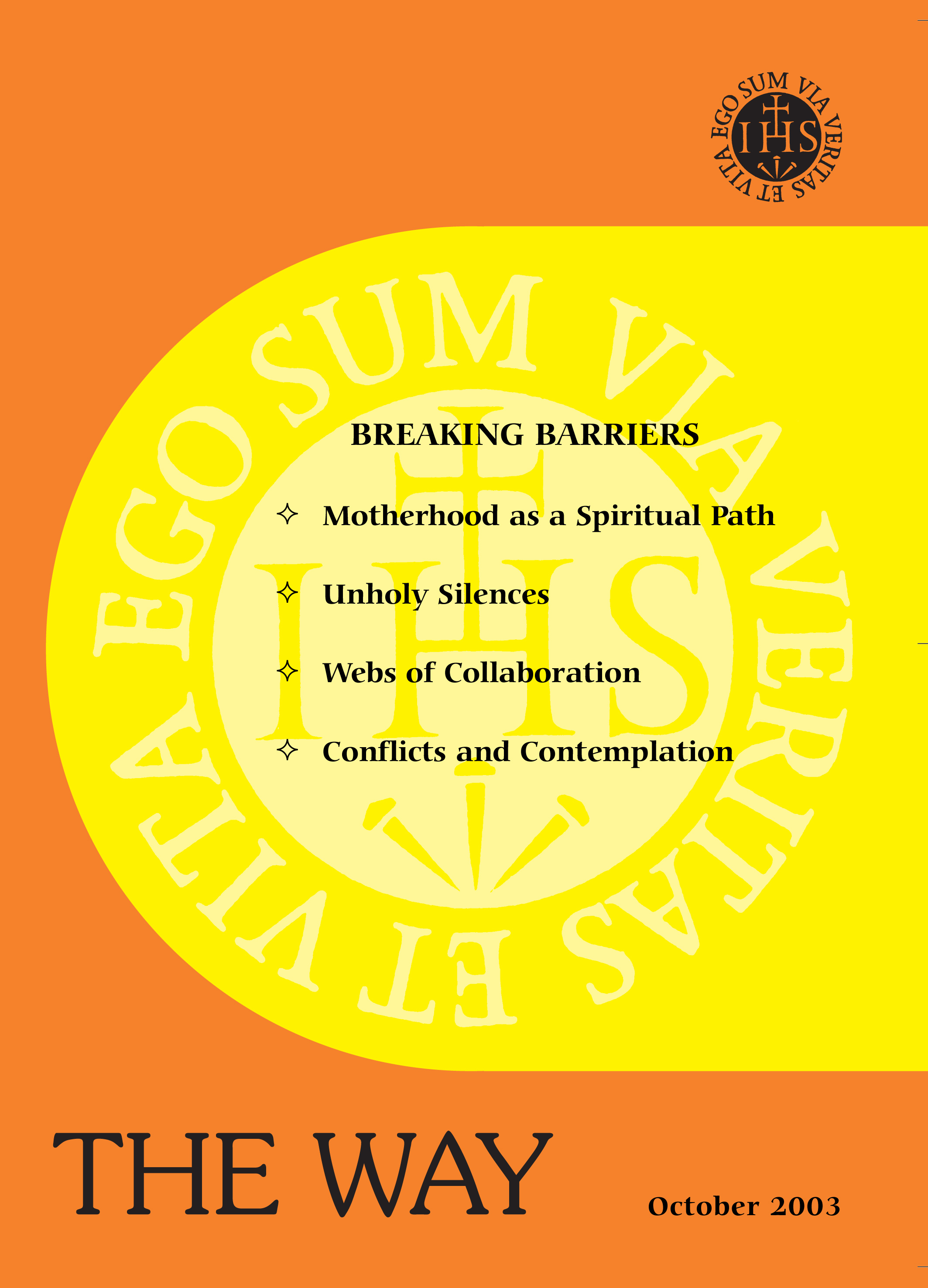
This issue is haunted by a sense of the Spirit gradually breaking down various kinds of barrier. There are barriers within our own psyches, therefore, to the touch of God. Perhaps one of them is the expectation that writing on spirituality should be undemanding. Or at least we may need to discern such expectations carefully. Communication of any kind—not just about spirituality—should be clear; jargon needs to be kept to a minimum, and carefully explained. The Way is absolutely committed to clear writing. But the spiritual life should always challenge us to be growing, to be questioning ‘how we have always thought’, to be exploring the possibility that God is leading us into something different. If ‘devotional writing’ remains within well-established categories, it stands at risk of merely fostering pious resistance. We do not yet have the words for what needs to be said; it is ‘so delightful that … it surpasses all understanding’. We cannot cope with the inclusiveness of God; we insist on confining the Spirit behind barriers of the most varied kinds. ‘Spirituality’ indicates how the realities of our experience are leading conventional theology, and standard devotional practice, towards an ever new, ever more inclusive, relation to God. By definition, it involves a closeness to everyday life. But it also involves learning to think and feel differently, breaking the barriers of habit and convention, both in thought and in feeling. Those lessons can never be straightforward.
Sue Delaney, ‘Motherhood as a Spiritual Path’, 8–20
Conventional offerings in ' spirituality' are normally beyond the reach of women who are mothers. Yet, Susan Delaney argues, motherhood is itself an important spiritual path that needs to be honoured in its own right.
John R. Quinn, ‘The Internet and the Church of the Future: The Coming of the Fourth Church’, 21–31
The former Archbishop of San Francisco wonders about the implications of the internet for the Church? What are the opportunities it offers us for growth and renewal? How is it going to affect the exercise of authority?
Christian Grondin, ‘Ignatian Identity in Transition’, 32–43
Some provocative reflections on what we mean by Ignatian collaboration, by the lay man who is Director of Programmes at the Ignatian retreat centre in Quebec City.
Gill Goulding, ‘Truth and Silence: Learning from Abuse’, 44–55
Rightly or wrongly--and quite inevitably--people working in church ministry sometimes feel abused by authority. Gill Goulding interviewed a range of people in such a situation, and here presents what she found.
Bernard Sesbouë, ‘Lay Ecclesial Ministers: A Theological Look into the Future’, 57–72
One of France's leading theologians explores the issues at stake when so-called 'lay people' are entrusted with the leadership of parishes. Awkward though some of the questions are, we seem on the threshold of a breakthrough.
Alfredo Sampaio Costa, ‘The ‘Times’ of Ignatian Election: The Wisdom of the Directories’, 73–88
Ignatius speaks of three ‘times’ during which a good and sound choice can be made. There have always been different views on whether one of these is more important and valid than the others, and about just what each consists in. Alfredo Sampaio Costa guides us through the arguments that took place in the important years after Ignatius’ death.
Jerónimo Nadal, ‘Spirit, Contemplation and Ministry’, 89–104
Three documents showing how the first generations of the Ignatian movement struggled with perennial issues in the spiritual life: inspiration and authority; heart and head; prayer and ministry.
Everard Mercurian, ‘Spirit, Contemplation and Ministry’, 89–104
Three documents showing how the first generations of the Ignatian movement struggled with perennial issues in the spiritual life: inspiration and authority; heart and head; prayer and ministry.
Claudio Acquaviva, ‘Spirit, Contemplation and Ministry’, 89–104
Three documents showing how the first generations of the Ignatian movement struggled with perennial issues in the spiritual life: inspiration and authority; heart and head; prayer and ministry.
Joseph Veale, ‘The Silence’, 106–117
The late Joe Veale asks some sharp questions about why there seems to be so little energy, enthusiasm--even consolation--in the mainstream Churches of western Europe.