
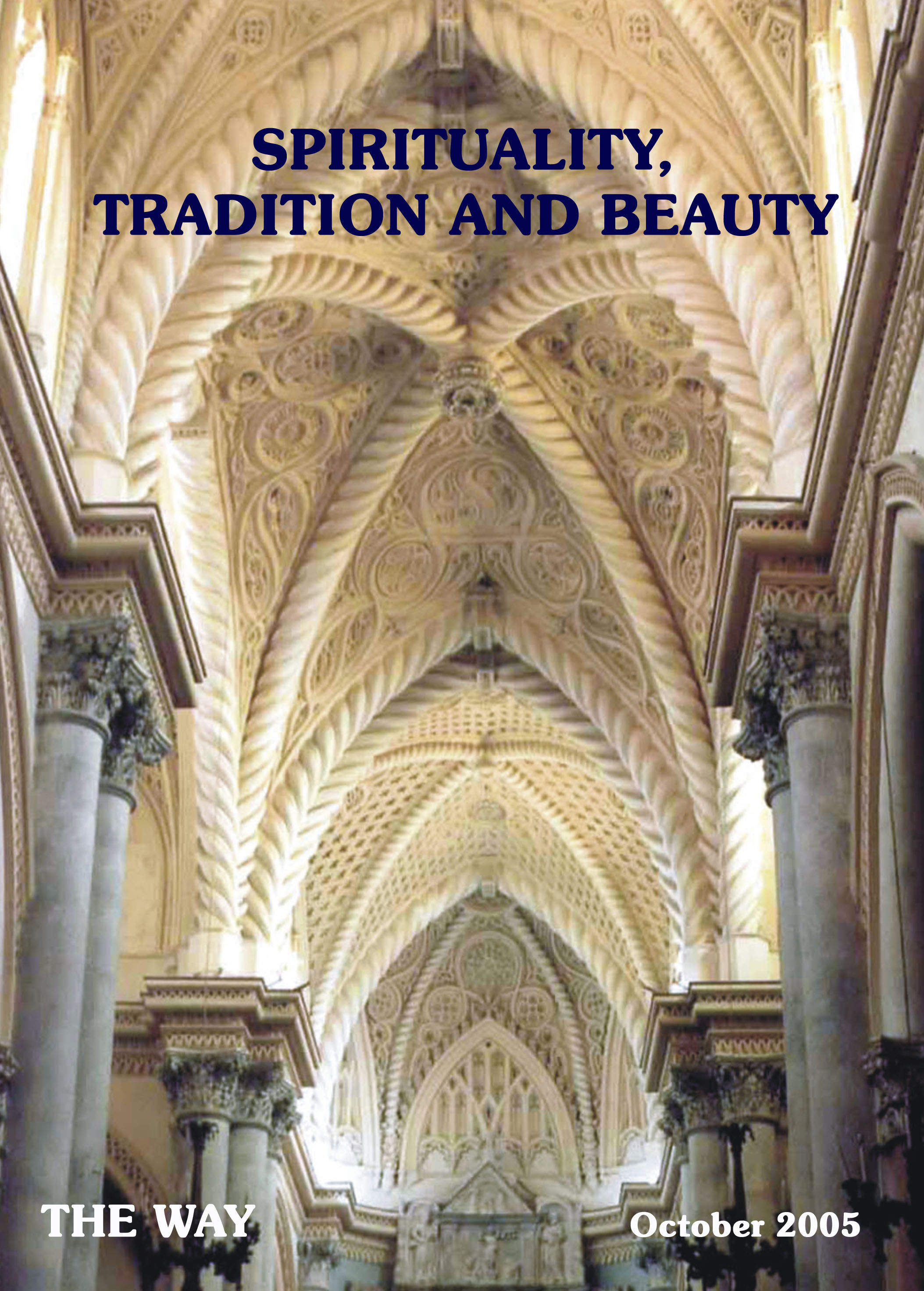
This special number of The Way honours Hans Urs von Balthasar’s centenary, and focuses chiefly on one theme in his work: what Gerald O’Collins refers to as the beauty of Christ. One can only be selective with Von Balthasar. His achievement is massive, and it is only now, as we go to press, that English translations of the final volumes of his major three-part work are being announced. Probably no one is yet in a position fully to appreciate how his work as a whole holds together. His legacy appears at present as a set of fascinating, controversial fragments, often pointing in different directions. In focusing on the themes of tradition and beauty, this collection in no way summarises von Balthasar’s achievement as a whole, nor resolves the questions it raises. The apprehension of divine beauty is only the beginning of the Balthasarian process, one that continues through the drama of God’s engagement and culminates in a reflection on divine logic. Christian tradition inevitably expands our sense of the beautiful, until it includes, like the creative love of God, the whole cosmos:
Gerald O’Collins, ‘The Beauty of Christ’, 7–20
A meditation on a sermon of Augustine’s about the beauty of Christ in every phase of his existence: his eternal generation; his incarnation, his cross and resurrection; his return to heaven.
Thomas J. McElligott, ‘Caravaggio and the Resurrection of the Body’, 21–35
How three great paintings by Caravaggio convey and nourish Christian faith in the resurrection of the body and soul—faith which involves commitment as well as assent.
Christine Valters Paintner, ‘Responding to Beauty’s Call: The Shape of an Aesthetic Spirituality’, 36–47
When we awaken to the call of beauty, we become aware of new ways of being in the world. Christine Valters Paintner considers how beauty, both natural and artistic, can nourish the spiritual life.
Joan L. Roccasalvo, ‘Hans Urs von Balthasar: Theologian of Beauty’, 49–63
An introduction to the life of the great theologian whom this collection celebrates, and an exploration of beauty’s role in his thought.
Leo J. O’Donovan, ‘On Pilgrimage to Chartres: Honouring the Centenary of Hans Urs von Balthasar’, 65–80
How one great building, the cathedral in Chartres, can open our hearts and spirits to prayer.
Philip McCosker, ‘‘Blessed Tension’: Barth and Von Balthasar on the Music of Mozart’, 81–95
Both von Balthasar and the great Reformed theologian, Karl Barth, lived in Basel. They became friends, and Barth was a major influence on von Balthasar’s work. Philip McCosker looks at the shared love of Mozart’s music that contributed much to their friendship.
John McDade, ‘Von Balthasar and the Office of Peter in the Church’, 97–114
How von Balthasar developed a vision of the Church as the interplay of different charisms, each of which contributes to the richness of the whole.
Werner Löser, ‘Hans Urs von Balthasar and Ignatius Loyola’, 115–130
Von Balthasar thought of himself as a dramatic theologian. A long-standing friend and editor of von Balthasar’s work looks at what this dramatic theology owed to the Ignatian Exercises and at how it can help us understand better the Contemplation to Attain Love.
Erhard Kunz, ‘The Divided Self, the Encounter with Christ, and the Journey of Commitment: Ignatius, Von Balthasar’, 131–145
In the Spiritual Exercises, sinful humanity confronts a God whose will is to save the whole human race and who draws us into the implementation of that project. Erhard Kunz shows how this vision shapes not only Ignatius’ writing, but also von Balthasar’s massive theology.
Andrew Louth, ‘Tradition and the Icon’, 147–159
Icons have become familiar well beyond the boundaries of Orthodox Christianity. Andrew Louth here explains the rich sense of Tradition which they express, and explores how the practice of icon painting has changed over time.
Tina Beattie, ‘Sex, Death and Melodrama: A Feminist Critique of Hans Urs von Balthasar’, 160–176
A look at the problems raised by von Balthasar’s richly symbolic theology for many feminists, particularly when people use it to support restrictive positions about women’s vocations.