
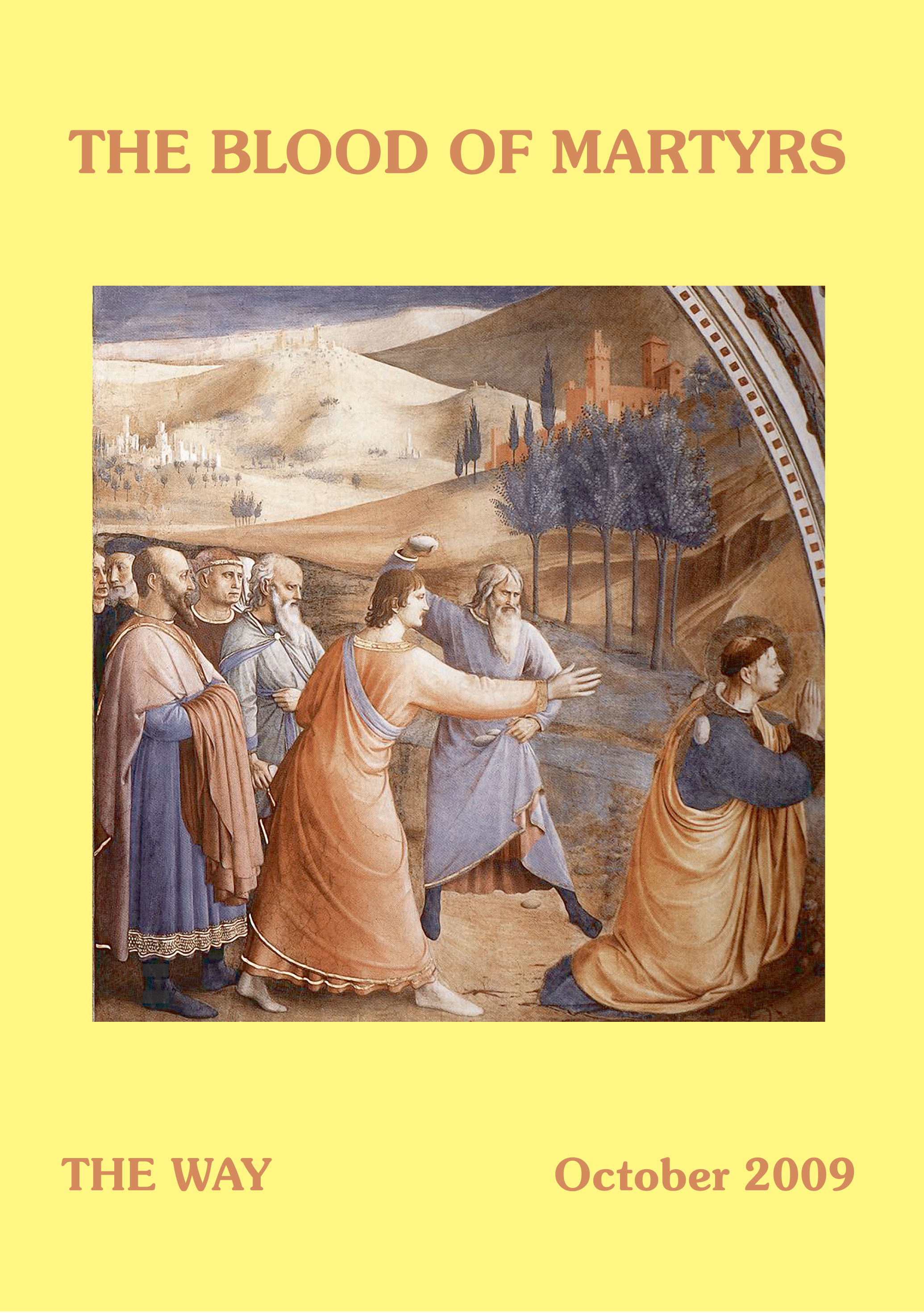
By 1989 the Central American state of El Salvador had been split by civil war for a decade. Throughout the war, one group that had been particularly targeted was those priests who, influenced by the ‘preferential option for the poor’ that was a key tenet of liberation theology, had stood alongside the impoverished majority of the population. On the night of 16 November 1989, six Jesuits working at the University of Central America, as well as their housekeeper and her daughter, were taken from their beds by armed men and shot, their bodies left in the garden of their residence. This issue of The Way marks the twentieth anniversary of the deaths of the El Salvador martyrs. Marking this anniversary offers an opportunity to consider the wider question of martyrdom, a category currently controversial in so far as it is claimed by, or assigned to, suicide bombers and ‘freedom fighters’ across the globe.
Michael Campbell-Johnston, ‘‘Be a Patriot: Kill a Priest’’, 9–16
‘C-J’ knew all those who died in the killings at the University of Central America. This commemorative issue begins by reprinting an article that he wrote in the immediate aftermath of their deaths, in an attempt to respond to the question ‘Why?’
Pamela Hussey, ‘An Empty Tomb’, 17–22
A year after the martyrs died, an open-air Mass was celebrated in El Salvador in their memory, attended by over 5,000 people. Pamela Hussey, who at the time worked for the Catholic Institute for International Relations, was there and describes how their legacy was felt at that time.
Clare Dixon, ‘The Martyrs of the University of Central America: Twenty Years On’, 23–35
Through her work at CAFOD (the Catholic Fund for Overseas Development) Clare Dixon has had a close connection with the countries of Central America for many years. After her most recent visit she uses the anniversary to ask how the martyrs’ witness can help those who would engage in a contemporary social apostolate in El Salvador and elsewhere.
Simone Lindorfer, ‘Liberation Psychology: An Approach to the Reality of Traumatism in East Africa’, 37–51
One of those who was killed in El Salvador, Ignacio Martín-Baró, had developed a critique of current psychological methods from the perspective of liberation theology. Simone Lindorfer, who has worked with trauma victims in Africa, shows how this understanding has proved useful in a range of extreme conditions.
Nicholas King, ‘Opposing the Claims of Mammon Biblical Reflections on the El Salvador Martyrs’, 53–66
Nicholas King is part-way through a translation of the whole of the Greek Christian scriptures. He is thus in an excellent position to consider the ways in which the Bible presents the idea of martyrdom, in particular in the New Testament.
Anonymous , ‘The Minds of the Martyrs’, 67–78
The Roman Catholic martyrs of the sixteenth and seventeenth centuries in England and Wales were killed by other Christians who were equally passionate in their beliefs. In the From the Ignatian Tradition strand of this issue we present contemporary reflections upon their situation from a variety of perspectives.
Damian Howard, ‘Differently Crucified: Understanding the Islamic Martyrs’, 79–94
One reason that the concept of martyrdom is currently in the news is because of The Way it is being used, rightly or wrongly, to describe the actions of a small group of radicalised Muslims. Damian Howard, who has just completed doctoral studies in Islamic thought, here outlines some of the variety of ways in which Islam has considered its martyrs.
Hüseyin Cicek, ‘Martyrdom in Judaism, Christianity and Islam: Analogies and Differences’, 95–106
The French literary theorist René Girard developed a theory of 'scapegoating' that attempts to explain the origins of much human violence, including that which leads to martyrdom. Hüseyin Cicek’s article uses these ideas to consider the differences between The Ways in which martyrdom is understood in the three Abrahamic faiths.
Michael Kirwan, ‘Friday’s Children: A Reflection upon Contemporary Martyrdom’, 107–120
Martyrdom is perhaps most often thought of in church circles in purely religious terms—the fact that this is a death occasioned by a faith stance is, after all, what distinguishes the martyr from others who die violent deaths. Here Michael Kirwan argues that, nevertheless, 'Martyrdom is perhaps the most fundamental form of Christian political engagement’.
Paul Dominic, ‘People for All Seasons’, 121–129
In 2008 Christians in Orissa, India, found themselves under attack from their Hindu neighbours, and many were killed. The Indian Jesuit Paul Dominic was in Guyana when he heard of these deaths, and offers a reflection on their significance.
Paul Nicholson, ‘Not Peace but a Sword’, 131–140
It can at first sight seem that religions which profess peace as an important value often end up in conflict between themselves. Here Paul Nicholson presents the work of two authors who attempt to explain why this should be so