
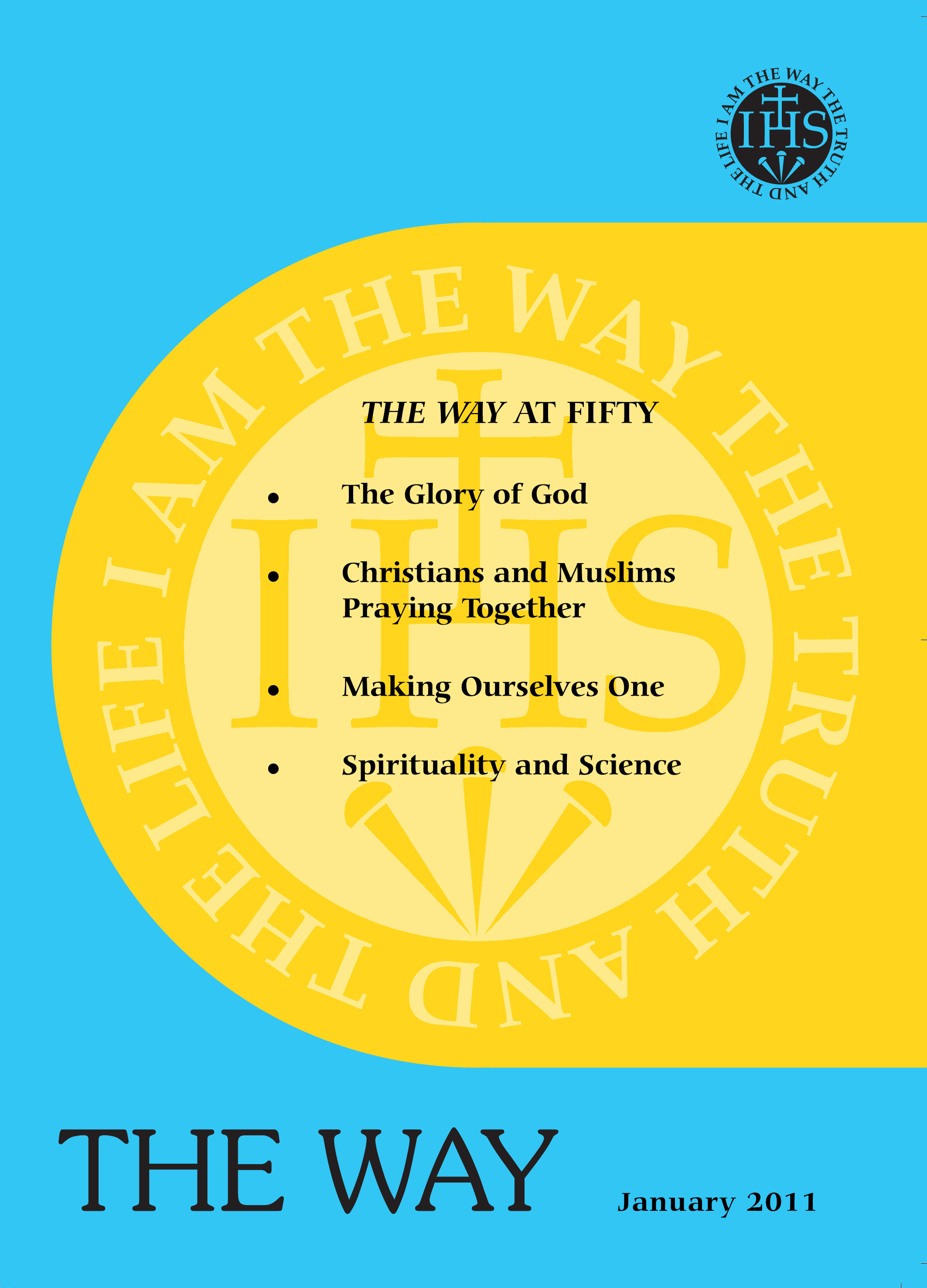
Fifty years ago this month The Way was published for the first time. Although Pope John XXIII had already announced his intention to hold the ecumenical council that would come to be known as Vatican II, as yet it neither had been summoned nor had met. The rediscovery of Ignatian spirituality that would be such a feature of the following two decades was foreseen by few. January 1961 was the month that John F. Kennedy became the 35th President of the United States, and it was a few months before the construction of the Berlin Wall, that potent symbol of Cold War divisions. It was, as the cliché has it, a different world. Jump forward fifty years, and nowadays The Way believes itself to be providing ‘a forum in which thoughtful Christians, from different walks of life and different traditions, can reflect on God’s continuing action in human experience’. A broader, more ecumenical, readership is addressed by a wider range of writers—it was not until the twelfth issue of The Way that you find an article written by a woman; and indeed the first non-clerical contribution was sufficiently novel to be entitled simply ‘A Layman’s Point of View’. An emphasis on experience has replaced a predominantly biblical or patristic outlook. But the desire to identify and reflect upon God’s action in the present historical moment has not changed. It is this that has always held the journal securely within the tradition of Ignatian spirituality, even when, as in this number, it offers contributions with different roots.
John Coventry, ‘The Way, 1961–1986’, 9–20
John Coventry was Jesuit Provincial of what was then known as the English Province when The Way first appeared in 1961. To mark its silver jubilee in 1986 he wrote an article describing the journal’s origins and the ‘somewhat chequered history’ of its first 25 years.
John Mahoney, ‘The Glory of God in St Johns’ Gospel’, 21–37
A primary concern of early numbers of The Way was to make biblical spirituality (a new concept for most Roman Catholics at the time) accessible to a broader audience. Jack Mahoney shows how this aim continues today.
John L. McKenzie, ‘Into the Desert’, 39–52
Continuing to mark The Way’s 50th anniversary, each edition this year will reprint an article from a different decade of publication. John L. McKenzie’s article, from the very first number of the journal, looks at different ways in which the experience of the desert helped shape people’s experience of God throughout the Bible. McKenzie was perhaps the foremost Roman Catholic biblical scholar of the 1960s, and died in 1991.
Christian W. Troll, ‘Can Christians and Muslims Pray Together?’, 53–70
During his pontificate Pope John Paul II risked controversy by praying publically together with members of the Muslim faith at a number of events which enjoyed wide coverage in the media. Christian Troll here asks how we can make sense of what is taking place on such occasions, if we are not to risk falling into a shallow syncretism or relativism.
Amy Hereford, ‘Mistress of Vision’, 71–83
Exploring feminine images of the Christian God may sound like a relatively modern preoccupation, associated with the development of feminism since the 1970s. However Amy Hereford argues that the writings of the Victorian poet Francis Thompson employ such images in new and creative ways that are deeply rooted in events of his own troubled life.
Toufic Makhoul, ‘Making Ourselves One in the thought and spirituality of Chiara Lubich’, 85–94
A key theme of Ignatian spirituality is that of 'inculturation', the process of adapting one's presentation of the gospel to the culture of those being addressed. Toufic Makhoul here shows how the thought of Chiara Lubich, founder of the Focolare movement, arrives at a similar way of proceeding from a subtly different series of motivations.
François Euvé, ‘A Spirituality for Scientists: Historical Overview’, 95–104
The possibility (or impossibility) of a link between science and religion continues to be a topic guaranteed to make headlines. François Euvé believes that this debate recognises ‘the rightful … autonomy of earthly affairs’, in a phrase taken from the Second Vatican Council. On this basis, he demonstrates links between the contemporary quests of science and spirituality.
Ruth Agnes Evans, ‘The Obedience of Jesus: Through the Eyes of Francis of Assisi’, 105–120
St Francis is sometimes presented as a gentle hippie saint, careless of money and basking in nature. Here Ruth Evans shows a very different side of his complex character. In a psalm Francis wrote meditating on the trial of Jesus before the Sanhedrin, Jesus abandonment o the Father’s will offers a challenging example of obedience to the saint of Assisi himself, and those who would follow his spiritual path