
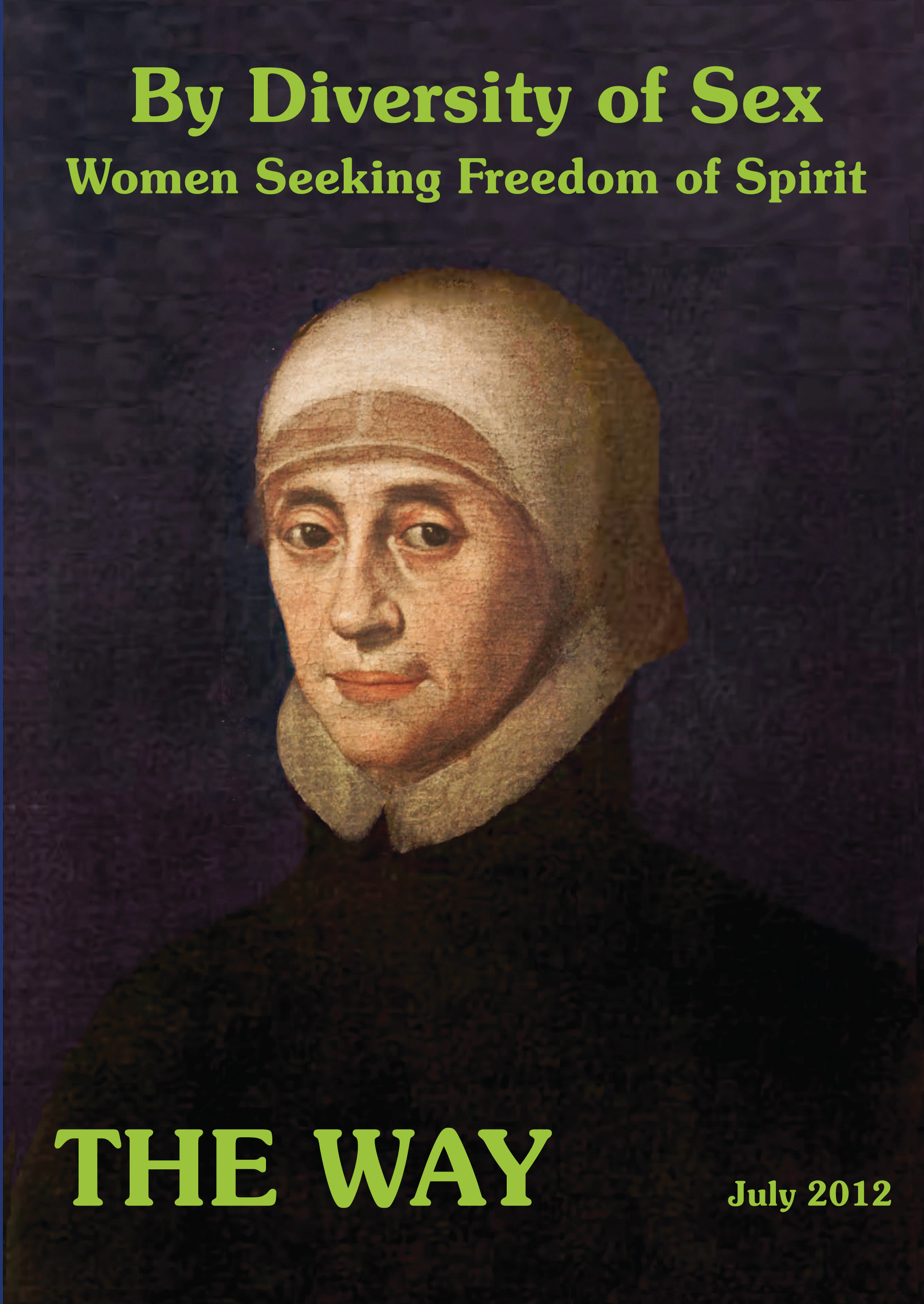
As this issue of The Way is being prepared for publication, the legislation to allow women to be ordained to the episcopacy is slowly making its way through the structures of the Church of England, in the face of vocal opposition from some. At the same time, the leadership of Roman Catholic women religious in the United States is being called to account by the Vatican on a number of issues, including the promotion of ‘radical feminist themes incompatible with the Catholic faith’. Plus ça change …. The articles in this Special Issue of our journal illustrate how the desire of some women to exercise ministry of one kind or another within the Church has for centuries been a source of controversy; but also that this desire is not easily quashed, and if suppressed shows a remarkable tendency to resurface later and often ultimately to win through. At the heart of the issue is a series of articles presented last year to a conference marking the fourth centenary of a significant event in the life of a Yorkshire woman, Mary Ward. After searching for some time, in 1609 she gathered a few companions around her, and eventually in 1611 she came to understand, through prayer, that the new congregation she was to found should be governed by the same Constitutions as the Society of Jesus—the Jesuits—and it is the anniversary of this insight that is marked here.
M. Gemma Simmonds, ‘Playing within the Rules’, 9–14
In this special issue, which focuses firstly on the life and work of Mary Ward, Gemma Simmonds offers a biographical sketch situating Ward in her times. How were women best to exercise ministry within a Church that was busy implementing the reforms of the Council of Trent? Answering this question would prove to be no straightforward task.
Mary Wright, ‘Mary Ward’s Dilemma: The Choice of a Rule’, 15–28
Mary Ward was deeply influenced by her contact with Jesuits, and wanted to take their Constitutions for the group of sisters she was forming. Mary Wright asks what other religious rules might have been available to her, and why she ultimately rejected each of them.
Brian O’Leary, ‘‘Hither I Must Come to Draw’: Mary Ward and the Ignatian Constitutions’, 29–41
The Jesuit Constitutions were composed to guide the lives of an order of male priests. Why then was Mary Ward so insistent, against considerable opposition, that they were applicable to the situation of her own fledgling congregation? Brian O’Leary, author of a recent study of the Constitutions, addresses this puzzle.
Gill Goulding, ‘‘Take the Same’ … But Differently: Mary Ward’s Appropriation of the Ignatian Charism’, 43–58
Mary Ward lived at a time when observance of the Roman Catholic faith in England was subject to a host of sanctions, small and great. Gill Goulding sees this context as a key to understanding how she needed to reappropriate and reinterpret the Jesuit Constitutions in the attempt to implement the experience in prayer that had led her to them.
Philip Endean, ‘Mary Ward and Jesuit Myths’, 59–77
If Mary Ward’s principle aim in life was to found a congregation of sisters living a mobile apostolic life on the Jesuit model, she failed. It took another three centuries before the Church was able to countenance such a possibility. Philip Endean argues that is it precisely this experience of repeated failure that shaped her appropriation of Ignatian spirituality, in a way inaccessible to the highly successful Jesuits of her time.
Janet K. Ruffing, ‘‘Ineluctable this Shimmering’: The Principle and Foundation’, 78–91
At the beginning of the Spiritual Exercises, Ignatius Loyola offers a world-view for all that follows, in his ‘Principle and Foundation’. Adaptation and application remain central to working with the Exercises to this day. Here Janet Ruffing asks what this key Ignatian text might look like from a contemporary eco-feminist perspective.
Juan Miguel Marin, ‘A Beguine’s Spectre: Marguerite Porete (d. 1310), Achille Gagliardi SJ (d. 1607), and Their Collaboration scross Time’, 93–110
Three centuries before Mary Ward another woman, Marguerite Porete, also fell foul of the church authorities, having argued for a freedom of spirit that they regarded as a severe threat to orthodoxy. At the end of the sixteenth century an Italian Jesuit, Achille Gagliardi, was moved by these controversial ideas, and so represented them in ways, Juan Marín argues, that then influenced much of the spiritual writing of the next hundred years.
Achille Gagliardi, ‘An Abridgment of Christian Perfection’, 113–122
Here, in our ‘From the Ignatian Tradition’ strand, we present extracts from An Abridgement of Christian Perfection, a seventeenth-century English translation by the Benedictine abbess Mary Percy of the influential work of Achille Gagliardi, to which Juan Marín’s article refers. In them he explores the idea of that ‘annihilation’ of the devout soul needed if growth in Christian living is to be achieved.
Oonagh Walker, ‘A Dialogue across Time: Julian of Norwich and Ignatius Loyola’, 123–134
For a dedicated reader, in Oonagh Walker’s experience, ‘The texts of a lifetime begin to talk to each other, and unlikely voices hold dialogue across centuries’. Here she describes one such dialogue, that between Julian of Norwich, the fourteenth-century anchorite and mystic, and Ignatius of Loyola, as revealed in his Spiritual Exercises.