
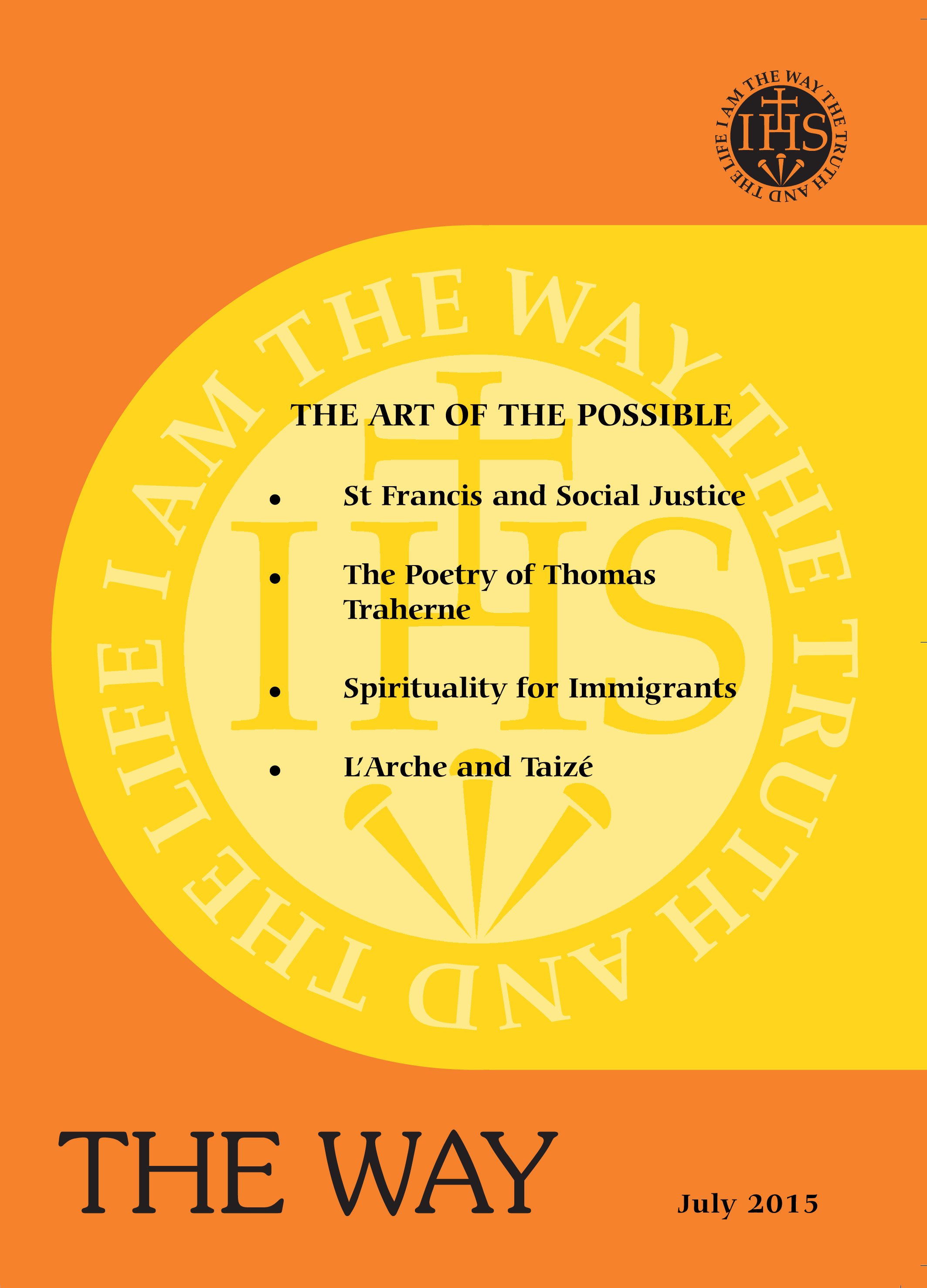
‘Politics is the art of the possible, the attainable, the next-best’, according to the nineteenth-century German Chancellor Otto von Bismarck. Where, then, does that leave spirituality? Some are perhaps tempted to see it as the polar opposite: the art of the impossible dream, striving always for the unattainable, unprepared to settle for anything less than the best. The approaches to spirituality to be found in the pages of The Way, varied though they are, have, I think, much more in common with Bismarck’s attitude than with this yearning for an unreachable goal. The articles in this issue certainly present aims and methods that it is reasonable to hope might in fact be implemented.
Jane Kopas, ‘A Coin and a Kiss: St Francis and Social Justice’, 7–19
Francis of Assisi is perhaps the most popular saint in Christian history. Yet in popular piety he is often presented as a sentimental hippy type, preaching to the animals. Is it possible to get back beyond the legends and rediscover in Francis a passionate advocate for justice? Kopas argues here that it is, pointing to the qualities of solidarity, empathy and a non-judgemental approach as characteristic of the saint.
Robert R. Marsh, ‘‘I Know the Gift Can Only Be Returned’: Giving and Giving Back in the Contemplatio’, 21–30
Ignatius draws his Spiritual Exercises to a close with the Contemplatio ad Amorem, a prayer whose title suggests that it is focused on love. Yet as the prayer unfolds it proves to be more concerned with ideas of gift and giftedness. The Jesuit writer Robert R. Marsh wonders why this should be so, and his resulting exploration shows how considering love and gift together in this way leads the one praying deeper into sharing the life of God.
Hung Trug Pham, ‘‘Am I My Brother’s Keeper?‘: Searching for a Spirituality for Immigrants’, 31–43
Whether and how immigration should be controlled is one of the most politically explosive issues confronting the world’s wealthier societies today. Pham uses the story of Joseph from the book of Genesis to draw out aspects of the experience of contemporary migrants, and to suggest ways in which they might better relate to the societies of their new homelands and in which these societies might relate to them.
Robert E. Doud, ‘Thomas Traherne’s Spiritual Poetry: Some Philosophical Considerations’, 45–60
Thomas Traherne was a seventeenth-century English metaphysical poet, much of whose work has only been rediscovered relatively recently. Here Robert Doud analyzes four of his religious poems, finding in them a detailed portrayal of the desire that, for Traherne, is a key characteristic of God and thus a central aspect of the Christian faith.
George B. Wilson, ‘Organizational Policy and Spirituality’, 61–68
Most people would not consider the question of organizational policy to be a particularly spiritual one. George Wilson thinks this is a result of our regrettable tendency to ‘keep the sacred and the secular in separate psychic boxes’. Using the example of Jesuit debates about the nature of their religious poverty, he demonstrates the links between policy formation and spiritual discernment.
Johannes Hoff, ‘Contemplation, Silence and the Return to Reality’, 69–78
Contemporary Western culture often seems to be wary of stillness and silence, feeling more comfortable with activity and noise. Johannes Hoff links this to the modern idea of the detached scientific observer, who tries to view the world objectively, from the outside. He contrasts this herewith an attitude of contemplative engagement, which alone will enable us to live properly human lives.
Meredith Secomb, ‘Responding to the Call of God: How Mission Makes the Person for Hans Urs von Balthasar’, 79–92
In recent decades the idea of vocation has widened to include not only the call from God received by ordained ministers and vowed religious, but also the sense to which every Christian can come of who he or she is before God. Secomb here presents the thinking of the twentieth-century theologian Hans Urs von Balthasar on the link between vocation thus understood, and an awareness of being sent out— missioned—by God.
Carolyn Chau, ‘Religion and Justice: The Faith-Based, Intercultural Peacemaking of L’Arche and the Community of Taizé’, 93–104
Two contrasting ecumenical communities, founded during the twentieth century, have continued to grow and flourish since. L’Arche integrates small groups of people with disabilities and those without into mutually supportive communities. Taizé reimagines traditional monasticism in a way that transcends denominational boundaries. Chau considers how these two initiatives each contribute to building the peace of God’s Kingdom.