
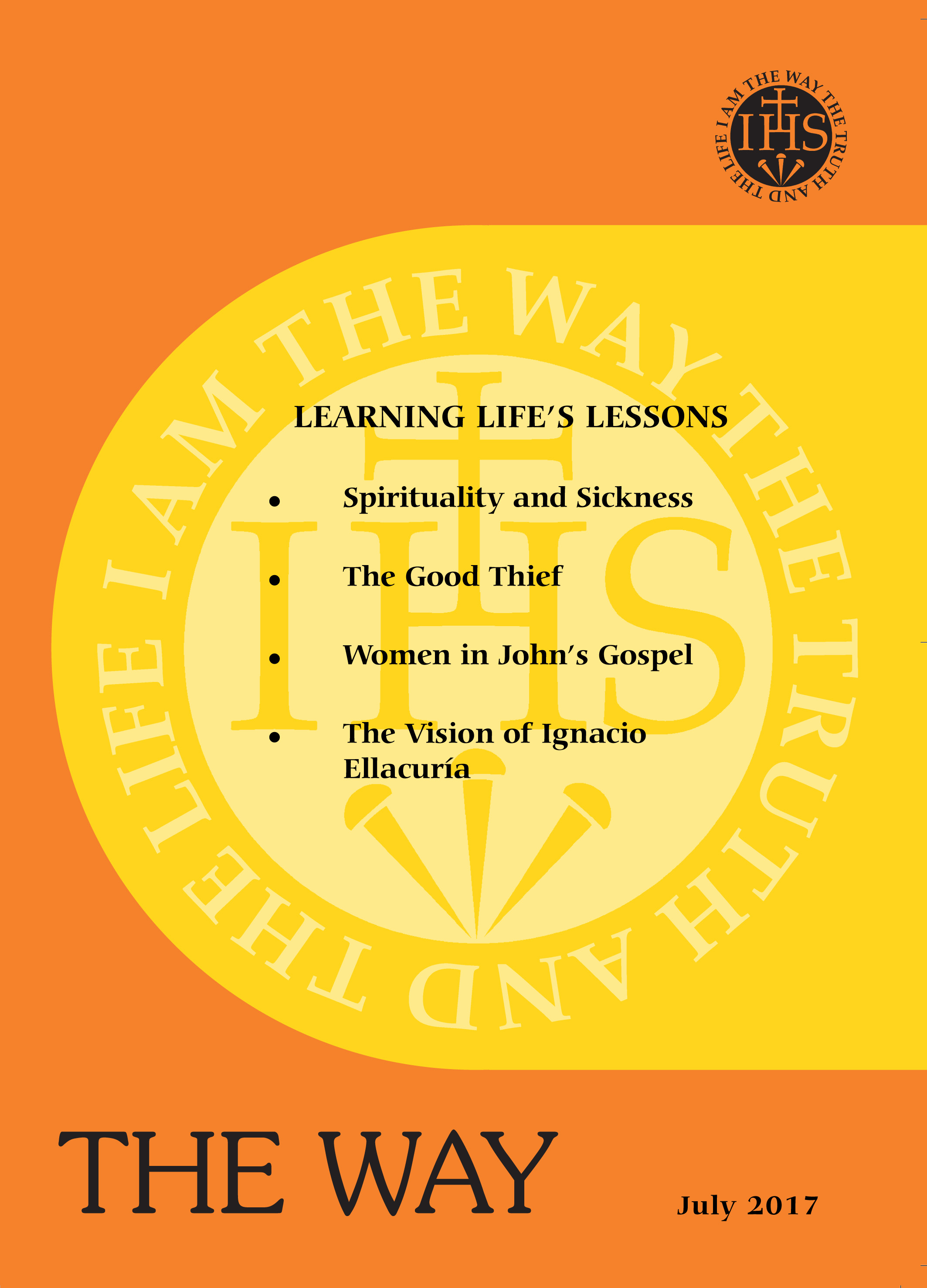
‘For better, for worse, for richer for poorer, in sickness and in health ….’ These familiar words, taken from the marriage vows in the Anglican Book of Common Prayer, point to the need for commitment in bad times as well as good if we are to learn all that life has to teach us—lessons go on being offered until, as the next phrase puts it, ‘death us do part’. These lessons are not, obviously, restricted to married people. You will find in this issue of The Way much evidence of the kind of wisdom that can perhaps only be gained by reflecting on the experiences of sickness and suffering.
Paul L. Younger, ‘Lost For Words: An Ignatian Encounter with Divine Love in Aggressive Brain Cancer’, 7–17
During a holiday in France in 2016, Paul Younger fell ill and was diagnosed with an aggressive brain tumour. Inevitably, his life has been radically changed by this, and his subsequent treatment. As a man schooled in the Spiritual Exercises, he found himself drawing deeply on the resources of Ignatian spirituality to discover God at work even here.
Ruth Agnes Evans, ‘The Good Thief’, 18–28
The gospel of Luke describes how a thief, crucified beside Christ, offers him a few kind words, and in turn receives a promise that he will enter Paradise alongside Jesus. The unexpected death of a much-loved uncle led Ruth Evans to reflect upon this story, seeing in it a dialogue of great significance for those struggling to make sense of life or facing their own death or of a loved one.
Ambrose Mong, ‘A Different World is Possible: Vision of Ignacio Ellacuría’, 29–42
Ignacio Ellacuría was one of a group of Jesuit victims of government death squads during the El Salvador civil war of the 1980s. As rector of the University of Central America, he analyzed the political situation of his country from the viewpoint of the poor. Ambrose Mong shows how his work has inspired later theologians to argue that presenting visions of alternative ways of living is an essential part of the Christian mission.
José García de Castro, ‘Juan Alfonso de Polanco: Memory, Identity and Mission’, 43–55
Juan Alfonso de Polanco was, for a crucial decade in the early years of the Society of Jesus, the secretary and confidante of St Ignatius. His writings played an important role in setting the future direction for Jesuit life and ministry. José García de Castro offers the example of his life as an indication of the importance of a lived sense of history within an institution.
Christine Burke, ‘Mary Ward: To Be or Not to Be … a Saint’, 57–69
Early in the seventeenth century Mary Ward tried to establish a religious order for women modelled on the Jesuits. She faced implacable opposition and persecution from within the church. It would take another two centuries before something like her vision was realised. Christine Burke argues that securing her canonisation would send an important message to those putting forward new ideas in today’s Church.
A. Paul Dominic, ‘The Dialectics of Prayer and Sleep’, 71–80
In the Garden of Gethsemane, the night before he died, Jesus invited his closest disciples to ‘Stay awake and pray’. Sleep can be regarded as an enemy by those trying to pray. Yet, as Paul Dominic suggests here, the relationship between prayer and wakefulness is more complicated than this might suppose, and indeed God may sometimes be best encountered within sleep itself.
Oonagh Walker, ‘Exodus: A Journey Through Sickness’, 81–88
According to the gospel accounts, Jesus spent much of his public ministry confronting sickness and its causes. Present-day society often avoids and isolates illness, regarding it as a defeat for medical science. Here Oonagh Walker reflects on her own expe
Jade Marie Lasiste, ‘The Science of Affections: The Ignatian Spiritual Exercises through Thomas Aquinas’, 89–100
In the Jesuit Constitutions St Ignatius advised that all Jesuits training for the priesthood be instructed in the works of St Thomas Aquinas, a theologian whose work had greatly influenced his own studies in Paris. One place where this influence can be traced is in text of the Spiritual Exercises. Jade Marie Lasiste here shows how Ignatius’ use of the term ‘affections’ can be illuminated by comparison with Aquinas.
Daniel Kearney, ‘‘What Do You Want From Her?’ Women in the Gospel of John’, 101–108
The Roman Catholic Church is beginning to look at the possibility of new roles for women within its organization. The scripture scholar Raymond Brown suggested in 1975 that the gospel of John provides a good resource for this investigation, in its portrayal of the women who were close to Jesus. Daniel Kearney considers what we might learn from their witness.