
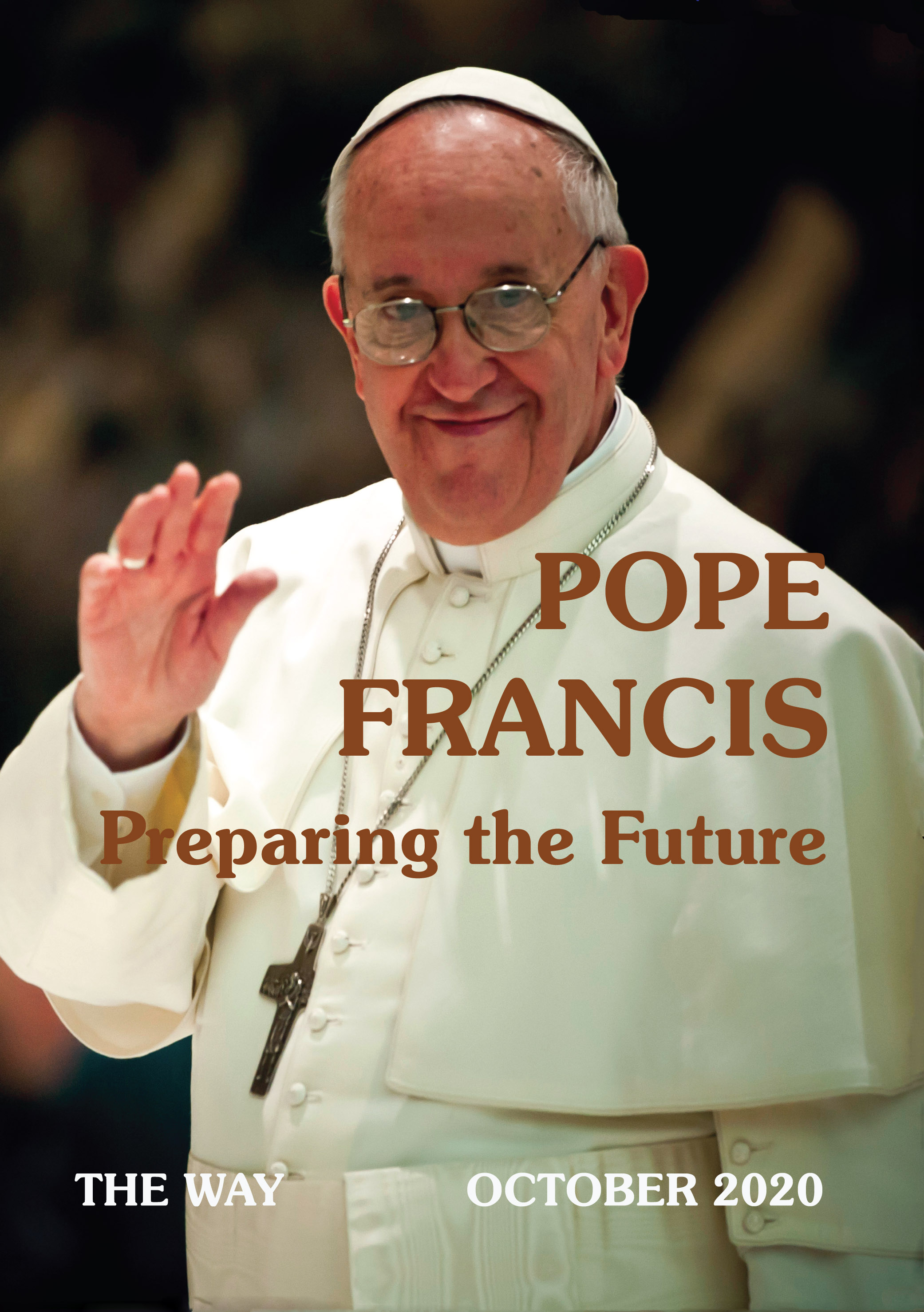
‘Buona sera!’ The first words that the world heard from the newly elected Pope Francis, on 13 March 2013, were a simple ‘good evening!’ In the seven years since then, he has continued to attract the world’s attention, by his words and by his actions. Among the words, his 2015 encyclical Laudato si’, putting care for the environment at the heart of church teaching, stands out. But perhaps his actions speak even louder. From carrying his own case, and washing the feet of women and Muslims on Holy Thursday, to standing alone to pray in a rainswept St Peter’s Square at the height of the pandemic lockdown, Jorge Bergoglio has an instinctive grasp of how to witness to the gospel that he preaches. This special issue of The Way considers the work of Pope Francis to date, in both what he has said and what he has done, and looks at its impact on the Church of today and tomorrow.
Michael Kirwan, ‘‘Swearing, Blaspheming, Wounding, Killing, Going to Hell …’: The World, as Seen and Heard by Ignatius’, 77–89
The conference at St Beuno’s started by taking a close look at the contemporary world. At the start of the Second Week of the Spiritual Exercises, Ignatius invited the retreatant to see the Trinity doing the same thing. Michael Kirwan explores some of the consequences of adopting this starting-point for prayer and reflection.
Tim McEvoy, ‘A Time of Choosing: Conversion and Discernment in the Mind of Pope Francis’, 7–12
It is frequently said that one of the distinguishing features of the current papacy is Pope Francis’s employment of discernment in decision-making. Tim McEvoy here looks at what this means in practice, and how in the Pope’s mind discernment is closely linked to the idea of conversion, something he believes in urgently needed in the contemporary world.
Austen Ivereigh, ‘Pope Francis: Reform and Resistance’, 13–28
Austen Ivereigh is the author of two major studies of Pope Francis. In the first, written in 2014, he now recognises that he offered a picture of the Pope as a heroic leader in a way that Francis himself would certainly reject. Here, by contrast, he views the current papacy through the lens of ‘post-heroic discerning leadership’.
Gemma Simmonds, ‘Mothering Sundays: Pope Francis and the Challenge of Women’s Role within the Church’, 29–39
What Pope Francis has said and done about the role of women in the Church has attracted much attention, both from within the Church and outside it, since the earliest days of his papacy. Gemma Simmonds here assesses his record here, finding both light and shadows, and recognising that there is still much to be achieved.
Elizabeth A. Hoare, ‘Protestants and Pope Francis: A View from outside the Roman Catholic Tradition’, 41–52
Robert Burns famously sought the gift of being able ‘to see oursels as others see us’. Here Elizabeth Hoare offers a view of Pope Francis from an evangelical Protestant perspective. While appreciating his teaching, she finds in the Pope’s character, particularly in his humility, a source of encouragement not just for evangelical Protestants, but for those of other faiths and none.
James Hanvey, ‘Papa Francesco: Quo vadis?’, 53–74
It is James Hanvey’s belief that the papacy of Pope Francis ‘marks a critical moment in the future direction of the Church’. In this article he outlines the key features of this critical moment. Central is placing a deepened sense of God’s compassion and mercy at the heart of everything to which the Church is to bear witness, an outlook that Francis lives out as well as preaching.
Jorge Mario Bergoglio, ‘The Cross and the Mission’, 75–83
In 1984 Jorge Bergoglio, later to become Pope Francis, was working as rector of the Colegio Máximo, the Jesuit House of Studies in Argentina. This article, originally given as a retreat talk to the Mary Ward sisters, was published that year. In it he offers a personal reflection on the place of suffering in the life of one who is entrusted with a mission from God.
Guillermo Randle, ‘The Spirit of Christ and of the Gospel in Pope Francis’, 84–88
By looking closely at both the actions and the teaching of Pope Francis, it is possible to come to a clearer view of the spirit that motivates and sustains him. For Guillermo Randle, two key aspects of that spirit are discernment and the cross. In this essay he traces the links between these two key aspects of the Pope’s own spirituality.
Massimo Faggioli, ‘Synod and Synodality in Pope Francis’s Words’, 89–100
In his quest to help the Church as a whole to become a more genuinely discerning body, Pope Francis has relied heavily on synods to gather and reflect prayerfully on issues facing the People of God. Massimo Faggioli here sets out the ways in which the Pope has explained the meaning of synodality, and the part that it plays in his ecclesiology.
Gerry O’Hanlon, ‘Pope Francis and Church Reform’, 101–111
At least since the days of the Second Vatican Council it has been commonplace to speak of the need for renewal in the Church. However, Gerry O’Hanlon sees in Francis’s papacy an emphasis, too, on reform, reviewing and updating the structures through which the Church carries out its mission. The next synod, itself focussing on synodality, could be vital in this regard.
Dushan Croos, ‘Christ is Alive: Preparing the Future’, 112–122
n 2018 Pope Francis chaired a synod on ‘Young People, the Faith, and Vocational Discernment’. The following year he published a post-synodal apostolic exhortation, ‘Christus Vivit’. Dushan Croos, who works in a new Jesuit project with young adults in London, sees in the synod process the ‘See, Judge, Act’ methodology popularised by the Young Christian Workers.
Pierre de Charentenay, ‘The Geography of Pope Francis’, 123–132
Unlike their predecessors, Popes since the time of Paul VI in the years after the Vatican II have travelled widely throughout the world. Far from being mere tourist visits, these journeys have become a central part of the papal mission. Here Pierre de Charentenay suggests that tracing the places that he has chosen to visit reveals much about the apostolic priorities of Pope Francis.
Martin Maier, ‘Another World Is Necessary: Proposals from Ignacio Ellacuría and Pope Francis for a New Global Civilisation’, 133–147
Ignacio Ellacuría was one of the six Jesuits murdered by government forces in El Salvador in 1989. In his writings he critiqued the present world economic order in ways that have much in common with the responses to it made by Pope Francis. Here Martin Maier considers the alternative visons that these two Jesuits have put forward.