
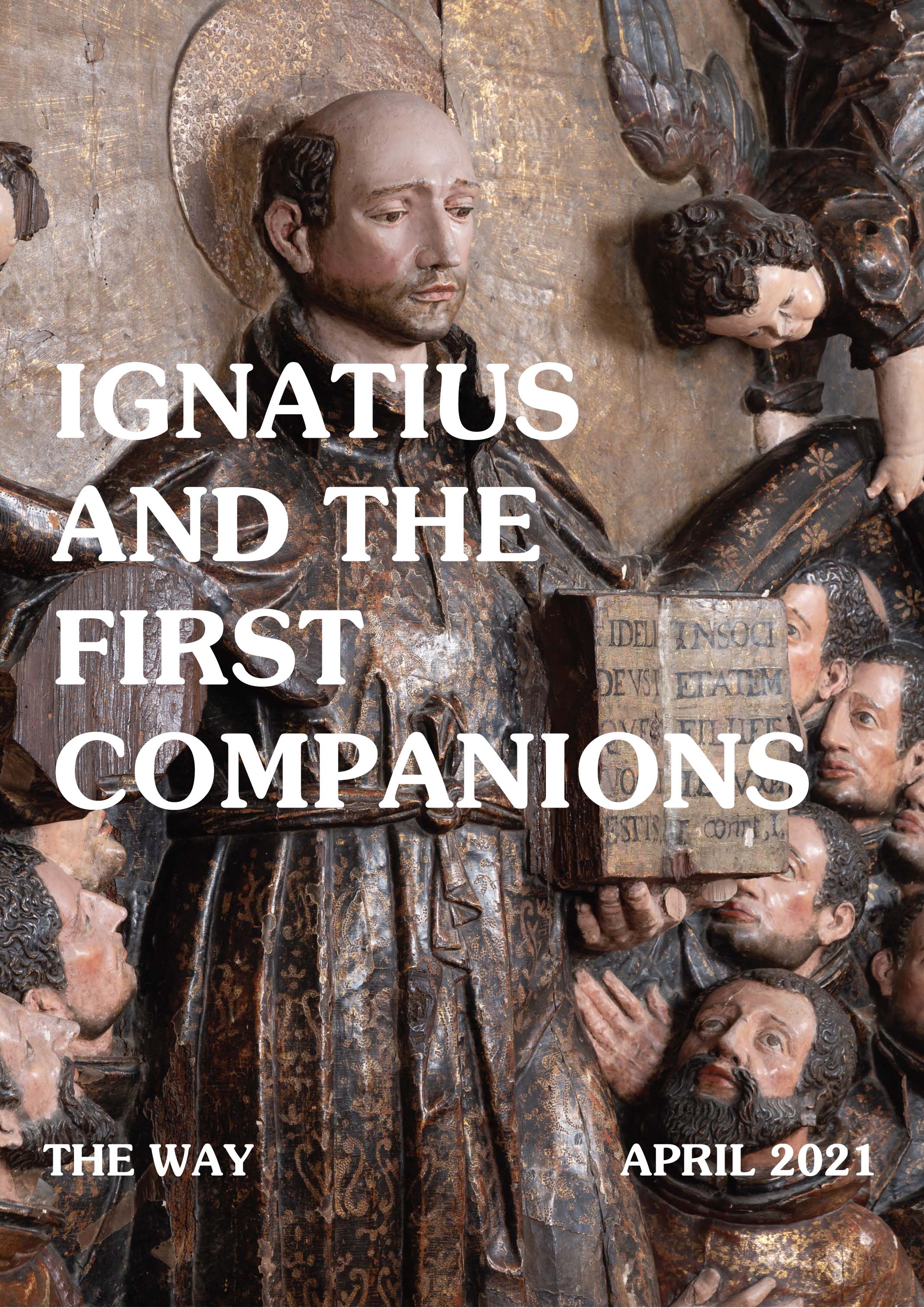
On 20 May 2021 it will be five hundred years since Ignatius of Loyola was wounded at Pamplona, triggering his conversion from dreams of military glory to the service of a greater Lord. Next year marks the four hundredth anniversary of the canonization of Ignatius and another of the first Jesuits, Francis Xavier. Spanning these events, the current Jesuit General, Arturo Sosa, has called for the celebration of an ‘Ignatian Year’, offering an opportunity to reflect upon the origins of this particular pathway to God. This Special Issue of The Way, focusing on the person of St Ignatius and his First Companions, is one contribution to that celebration.
Tim McEvoy, ‘Ignatius and the Stars’, 8–17
Ignatius of Loyola has a reputation as a hard-headed administrator, guiding and steering his nascent religious order from the heart of the Church in Rome. His personal writings, however, reveal other sides to his character. Here Tim McEvoy considers one of these, Ignatius’ predilection for gazing at the stars contemplatively, and asks what if might tell us about the man in the light of the cosmology of his time.
Timothy Gallagher, ‘Ignatian Discernment and Thomistic Prudence: Opposition or Harmony?’, 18–36
Although Ignatius has become well known in recent years as a teacher of discernment, his methods have attracted criticism at times. It has been suggested, for instance, that Ignatius’ thought lacks the precision to be found in the writings of Thomas Aquinas. In this article Timothy and David Gallagher discuss how the Thomistic virtue of prudence might relate to, and supplement, Ignatian discernment.
Gail Paxman, ‘Core Ingredients in Ignatius’ Recipe’, 37–45
The well-known spiritual writer Anthony de Mello likened the text of the Spiritual Exercises to a cookery book. Here Gail Paxman develops that simile, exploring six of the ‘key ingredients’ in the Ignatian system, and looking at how they work together to produce the kind of conversion that is the goal of the Exercises themselves.
Harvey D. Egan, ‘Ignatius Prayer and the Spiritual Exercises’, 47–58
What is Ignatian prayer? His Spiritual Diary suggests that Ignatius himself spent long hours in mystical contemplation, yet he forbade his earliest followers from following this example. A complex programme of imaginative contemplation has sometimes been seen as central to the Spiritual Exercises, yet they also suggest using whatever works. Harvey Egan sorts through these contrasting examples and practices.
Joseph A. Munitiz, ‘The Vocation of Jerónimo Nadal’, 59–66
When Ignatius wanted someone to promulgate and explain the new Jesuit Constitutions across Europe, he turned to Jerónimo Nadal, who then came to have a key role in the early Society of Jesus. A decade before his death in 1580 Nadal composed an account of his own vocation, a document known as the Chronicon. Joseph Munitiz asks what this can tell us about vocational discernment today.
Carlos Dominguez, ‘Ignatius of Loyola the First Retreatant: Psychological Traits of His Personality’, 67–85
Carlos Domínguez is both a professor of the psychology of religion and a practising psychotherapist. In this article he draws on both these areas to analyse the mystical experience of St Ignatius, which lies at the root of the spirituality that bears his name. This experience, Domínguez believes, decisively marked his personality.
John Zupez, ‘The Universal Apostolic Preferences of the Society of Jesus: A Brief Explanation’, 87–92
In 2019 the Society of Jesus adopted four ‘universal apostolic preferences’, intended to guide its planning and work over the next decade. These preferences offer a contemporary expression of what it means to choose a pattern of life shaped by the experience of Ignatian spirituality in the Spiritual Exercises. Jack Zupez offers here a brief introduction to the preferences and what follows from their adoption.
James Hanvey, ‘Frontiers of the Spirit: The Mission of Spirituality Today’, 93–108
Human beings typically come to understand themselves and their place in the world by constructing large-scale explanatory narratives. Scientific progress, and economic determinism, are two such secular narratives. Religious faiths offer contrasting narratives to compete with these. James Hanvey finds in the Jesuits’ ‘universal apostolic preferences’ elements that can bridge the sacred/secular divide.
Mark Rotsaert, ‘Pierre Favre through His Letters’, 109–126
Pierre Favre shared rooms with Ignatius Loyola and Francis Xavier when they studied together at the University of Paris, He went on to become the first ordained Jesuit, the one who, according to Ignatius, best understood the Spiritual Exercises. Here Mark Rotsaert uses Favre’s remaining extensive correspondence to complement the picture given in his Memoriale, his record of his spiritual life.
Joseph A. Munitiz, ‘The Vocation of Jerónimo Nadal’, 127–133
When Ignatius wanted someone to promulgate and explain the new Jesuit Constitutions across Europe, he turned to Jerónimo Nadal, who then came to have a key role in the early Society of Jesus. A decade before his death in 1580 Nadal composed an account of his own vocation, a document known as the Chronicon. Joseph Munitiz asks what this can tell us about vocational discernment today.
Hedwig Lewis, ‘The First Brothers of the Society of Jesus’, 134–144
As well as priests, there have always been non-ordained brothers in the Jesuit order. Recent research in Spain has given a detailed picture of the first four of these men. Hedwig Lewis draws on this research to present portraits of each of them, a Spaniard, and Italian, and two from Portugal, four ‘enthusiastic and committed laymen’.