
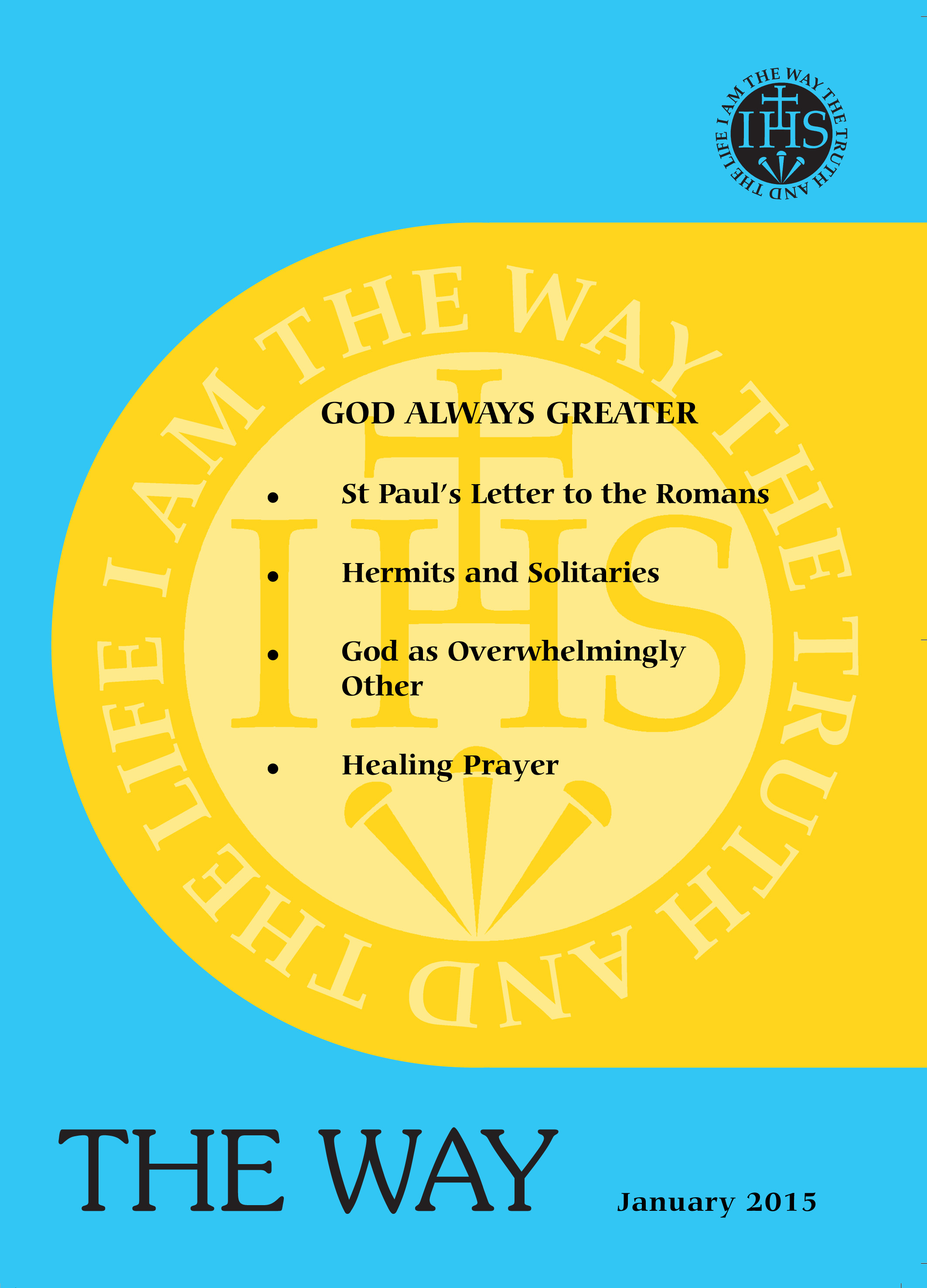
‘There is nothing in this world which does not belong to Christ, no human activity which is irrelevant to the Kingdom of Christ.’ These words are taken from an article by Gerry W. Hughes, written for The Way in the second year of the journal’s publication, more than half a century ago. Hughes, who has recently died at the age of ninety, was undoubtedly the best-known Jesuit spiritual writer of his generation. One of his books, God of Surprises, has to date sold nearly a quarter of a million copies, and has been translated into more than twenty languages. His last work, Cry of Wonder, appeared only a few months ago. Throughout his long life, his was an expansive spirituality, as the quotation above indicates, open to finding God—in a phrase to which he often returned—among ‘Catholics, Protestants and pagans’.
Robert E. Doud, ‘Coziness and Challenge in St Paul’s Letter to the Romans’, 7–15
Volumes have been written on the letter St Paul wrote to the Church in Rome, but few have found reading it, as Robert Doud does here, a cosy experience. Nevertheless, he makes a good case for ways in which he was also challenged by the letter as he pondered it during his novitiate, and in which we can still find ourselves challenged today.
Penelope Olive, ‘Models for Healing Prayer in Spiritual Directin: The Healing Ministry of Jesus; The Passion of Christ; The Consecration’, 16–26
The question of whether God can, or even wants to, heal those suffering from illness and disease is a recurring one in Christian history. As a result of reflecting on this question, Penelope Olive became involved in her Church’s healing ministry, and here she situates her experience in the context of the healings Jesus performed, as recorded in the gospels.
Bernhard Grom, ‘Towards a Spiritual Theology without a Psychology Gap’, 27–36
How is the relationship between spirituality and psychology best understood? The two are clearly related, yet are as clearly distinct. Spirituality centres draw on the insights of psychology in their training programmes, and psychologists are increasingly acknowledging the need to take account of their subjects’ religious beliefs. Bernhard Grom considers some of the issues these considerations highlight.
Bernadette Miles, ‘Incarnating Our Consolation through Transformative Academic Learning’, 37–50
The last issue of The Way dealt with the topic of how spirituality might best be taught. Continuing with this theme, Bernadette Miles describes an Australian formation programme that unites academic learning with a strong emphasis on the experience of those who are being trained. She suggests that such a programme regularly has transformative effects on its participants.
Kelley Spoerl, ‘Caryl Houselander: Divine Eccentric and Prophet of Vatican II’, 51–64
Caryll Houselander was one of the most widely-read Catholic authors of the mid twentieth century and, having fallen out of favour, is currently enjoying something of a revival. Kelley Spoerl here develops one aspect of her thought, that of the Mystical Body of Christ, and shows how she anticipates some of the thinking of the Second Vatican Council which took place a decade after her death.
Gregory Schweers, ‘Flannery O’Connor and the Problem of Baptism’, 65–74
As a Roman Catholic novelist in the southern states of the USA before the Second World War, Flannery O’Connor was a rarity. In this article Gregory Scweers analyzes one of her short stories, ‘The River’, and shows how it draws on the contrast between two typical views of baptism in her own time.
Carol McDonough, ‘Christian Hermits and Solitaries: Tracing the Antonian Hermit Traditions’, 76–89
Throughout Christian history a small minority have responded to a call to live solitary lives of prayer and penance. Carol McDonough traces this eremitical way of life back to St Antony, living in the Egyptian desert in the third and fourth centuries after Christ, and shows some of the diverse ways in which it has developed up until the present day.
Paul Moser, ‘God as Overwhelmingly Other: From Gethsemane Weakness to Faith’, 91–103
It can be tempting to worship a tame God, one who protects us but is essentially under our control. At the opposite end of the spectrum of religious experience is the encounter with a God who seems overwhelmingly other, provoking awe and perhaps even fear. Paul Moser recognises this kind of experience in the life of Christ, and asks what it might mean for believers today.
Ruth Agnes Evans, ‘The Exoneree and the Madonna: How Does Mary Standing beneath the Cross Speak to Usy’, 105–115
Starting from the experience of a man imprisoned for a decade for a crime of which he was subsequently cleared, Ruth Evans considers what the image of Christ’s mother, sharing his suffering by standing alongside him at the foot of the cross, might have to say to those condemned by the legal system. Are Mary’s grief and pain still able to offer solace to those who suffer in similar ways today?