
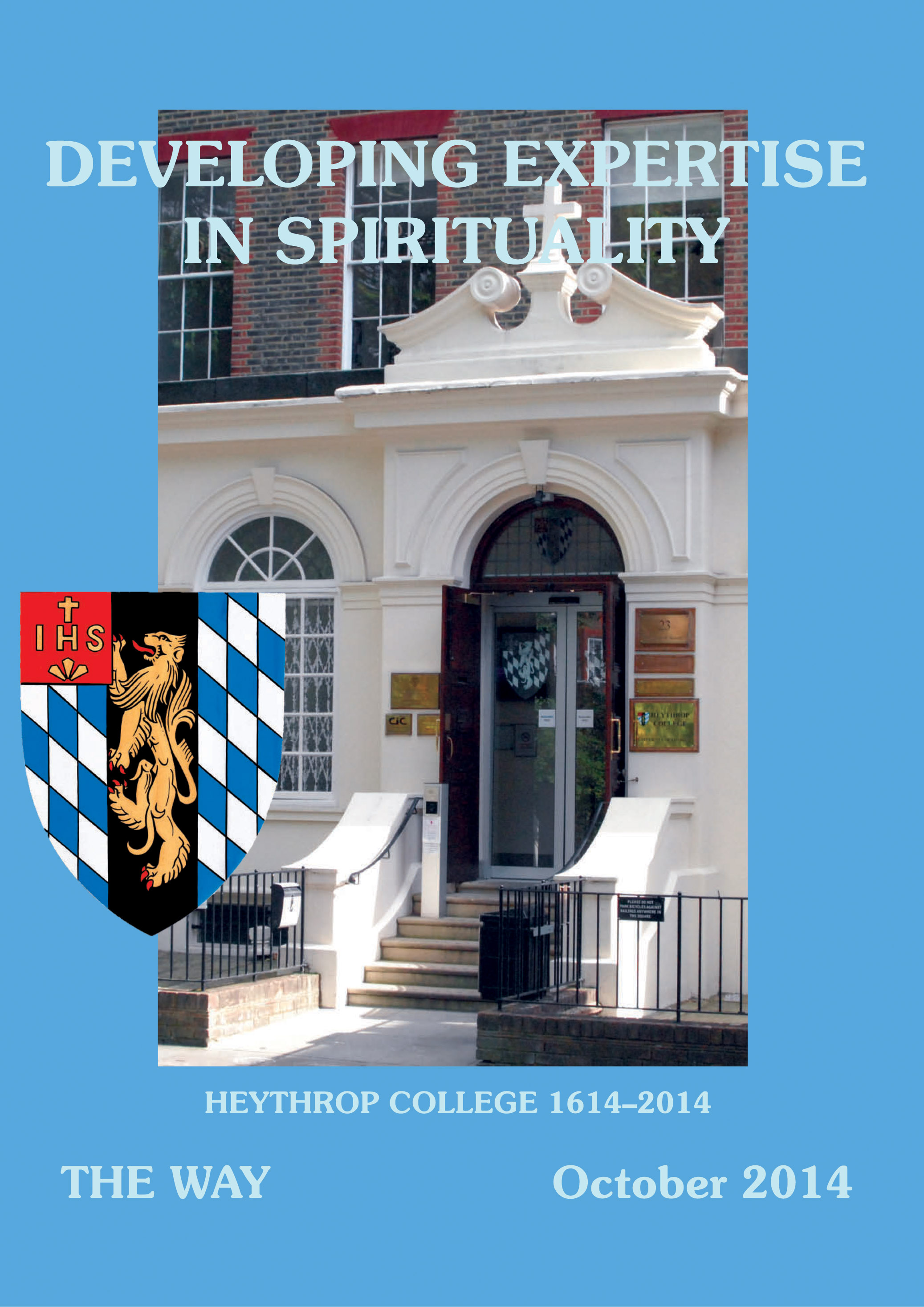
As you begin to read this foreword, I invite you first to pause and reflect for a moment. What would you expect an expert in spirituality to be like? There are (at least) two different kinds of answer to this question. One spontaneously considers spirituality as an academic discipline, a branch of theology and so, perhaps, having much in common with other disciplines such as history, literature, or even one of the sciences. From this perspective, an expert would be learned, well-read, an intellectual type. The other kind of answer regards spirituality as a practical skill or outlook, something developed and refined by religious practice. Here an expert would be one who is prayerful, empathetic, perhaps known as a good listener. Neither of these kinds of answer is any more correct than the other. Both find support and elucidation in the pages of this Special Issue of The Way. Four hundred years ago, Roman Catholicism was under attack in Britain. Any man wanting to train as a Catholic priest, or any child wanting a Catholic education, had little choice but to move to the European mainland, and to face great danger upon returning. Heythrop College, the Jesuit-run philosophy and theology college of London University, whose four-hundredth anniversary this issue of The Way celebrates, traces its origin to the Jesuit college founded in Louvain in 1614.
Edward Howells, ‘Personal Experience and Critical Distance in the Interpretation of Spiritual Texts’, 7–16
Edward Howells asks how the historical material considered in university spirituality courses can be studied in a way that remains open to the contemporary experience of students and others, without distorting or losing touch with its original inspiration.
Claire E. Wolfteich, ‘Teaching Spirituality: Context, Practice, Scholarship and Formation’, 17–28
The context in which spirituality is taught in the academy is usually very different from that in which the spiritual practices studied originated and are still employed. Yet it seems important that these two spheres should retain close links to one another. Claire Wolfteich reflects on some of The Ways in which these links can be maintained.
Annemarie Paulin-Campbell, ‘Teaching Spiritual Accompaniment in the Context of Trauma’, 29–44
Even two decades after the fall of the apartheid system in South Africa, many of that country’s citizens still bear the psychological scars that it inflicted. Anne Marie Paulin-Campbell draws on her work with the Jesuit Institute of South Africa to ask how spiritual directors can best be trained to deal with the kinds of trauma they encounter in this context.
Michael Smith, ‘Forming Spiritual Directors in an Academic Course’, 45–55
In Australia a Master of Arts in Spiritual Direction (MASD) course has been run for the last fourteen years. It is unusual in that it aims to form spiritual directors through an academic course. Here Michael Smith, Dean of the college running the course, reflects upon the challenges it has faced and the successes that it has achieved.
Robert R. Marsh, ‘Teaching Spiritual Direction as if God were Real’, 57–67
Rob Marsh has described in earlier issues of The Way a model of spiritual direction that starts from a sharp focus on the reality of God’s work in the life experience of the one being directed. In this article he considers the practical implications of such an approach for the training of spiritual directors, and thus the content of training courses.
Ruth Holgate, ‘Training Spiritual Directors’, 68–78
Is spiritual direction based on a set of skills that can be taught? Or are the best directors those who are recognised as possessors of an innate charism? Over the last decade Ruth Holgate has developed training programmes that acknowledge the charismatic element while rigorously promoting and evaluating the skills that support it.
Paul Nicholson, ‘Forming Directors: Training Programme or Apprenticeship?’, 79–87
Traditionally, spiritual directors were formed through a process of apprenticeship, working alongside those who were acknowledged to show some mastery of the process. Paul Nicholson suggests that this process is still a valid one today, although it may result in fewer new directors than are turned out by some contemporary training courses.
Janet Ruffing, ‘‘A God-Mother of the True Believers’: Teaching Spirituality in a Non-Denominational Seminary’, 89–100
Janet Ruffing is professor in the practice of spirituality and ministerial leadership at Yale Divinity School. In her experience almost all the students who enrol for her classes have a desire to explore their own spiritual experience. Ruffing describes how she has developed courses that allow for this kind of exploration.
Beth R. Crisp, ‘Do the Staff Need to Know What We Believe?’, 101–111
In Australia many social welfare agencies are run by, or at least have close associations with, faith communities. Yet the state funding that they receive demands that they make their services available to all, irrespective of belief. Beth Crisp asks how these organizations can help staff understand their faith roots without proselytizing.
Prashant Olalekar, ‘‘Come Play with Me’: Exploring New Frontiers of Body Wisdom’, 113–125
The author is an exponent of the InterPlay movement, which teaches a form of spirituality that takes the wisdom of the body and its awareness of its own needs very seriously. Here Prashant Olalekar describes how this has been developed in an Indian contex
Bernadette Flanagan, ‘Quaestio divina: Research as Spiritual Practice’, 126–136
For those undertaking initial postgraduate studies, the final thesis or dissertation looms large. This is as true for those studying spirituality as it is for any other discipline. Yet Bernadette Flanagan argues that these research projects have the poten